How Does a Football League Table Work? A Complete Guide to Understanding League Standings
Sun, 5th Jul, 2026
Why League Tables Matter
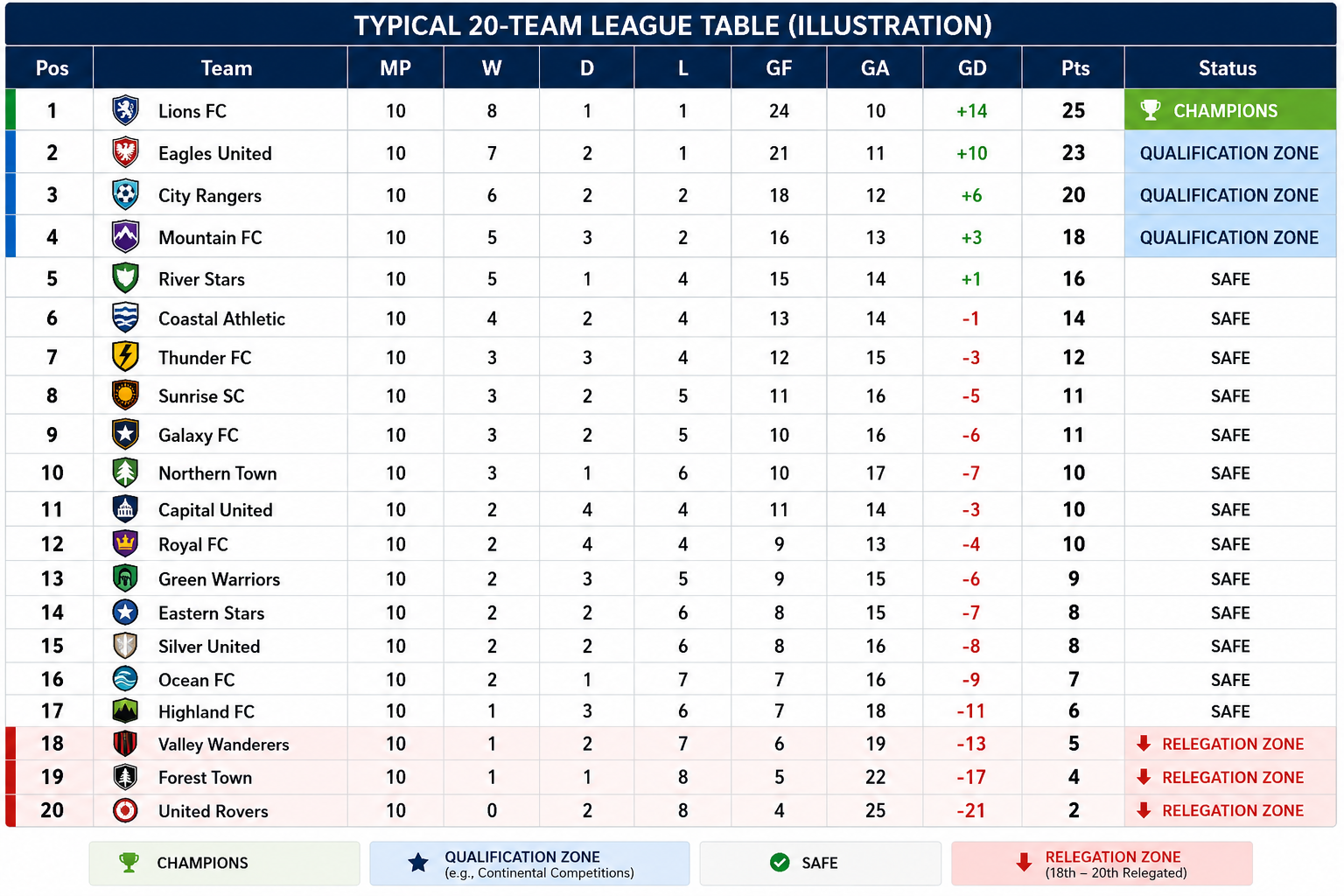
Millions of people check their smartphones every weekend to see where their team stands in the league table. This vertical list is displayed in newspapers and on sports websites. It tells you all about a season. It can look like a wall of numbers if you are new to the sport.
What is the difference in first and second places when both teams have equal points? Why can a team be ranked higher when they have more wins than another team? What is "goal difference" and why is this so important?
This guide will help you understand the standings of football leagues.
What is Football League Table?
A football league is a list that ranks all the teams in one division. The table is updated every matchday, and it serves as an official record of performances. League football rewards consistency over a number of matches, unlike knockout tournaments where a bad performance can be enough to send a team packing. There are no subjective or arbitrary scores. The table is math applied to sports.
The Building Blocks of the Basic System: Matches played, Position, and Points
Matches Played (MP or Pld)
This is the easiest column. This column shows the number of games that a team has played so far. In the top-flight, each team plays their opponents twice - once at home and again away - so a season is usually made up of 38 games. Even if one team has played less games than another, the position they hold in the table does not necessarily tell the full story.
Points (Pts)
Points are the currency of league football. The system is universal across nearly every league in the world:
-
Win: 3 points
-
Draw: 1 point
-
Loss: 0 points
Add these up across the season, and you get a team's total points. The team with the most points finishes first. It is that simple--until two or more teams are tied.
Reading the Full Table: What Every Column Means
The majority of league tables show more than just position and points. What do the other columns mean and why are they important?
Matches played (MP)
This is the total number of matches played by each team.
Wins (W), Draws (D), and Losses (L)
The three columns below break down the record of a team. It is possible that a team with many draws can be difficult to beat, but they struggle to win matches. A team that has few draws but many losses is either aggressive or inconsistent. The split between wins, draws, and losses can often explain how a team has earned its points.
Goals For (GF)
This column, which is sometimes referred to as "Goals", "F", or simply "Goals", tracks each goal that a team scored in a league. This is a measure of offensive strength.
Goals Against (GA)
This track goals conceded. This reflects the defensive organization of a team, goalkeeper performances, and how a team protects its lead.
Goal Difference (GD)
This is the difference between goals scored and conceded. This number is often displayed in parentheses, or even as a separate column. It determines the final position when there are no points.
To practically demonstrate this, visit our hompage https://ligapredict.com click and open any match, patiently scroll down, the league table of the teams will display, you will see the teams position in the table. With this, you can properly predict.
When Teams Are Tied: The Tie-Breaker Hierarchy
There are always ties in the points, especially at the lower and middle parts of the table. There are strict rules in leagues about how to break ties. Order of tiebreakers may vary slightly depending on the competition. However, most systems look like this:
1. Goal Difference (GD)
In most leagues, the goal difference is the most important tiebreaker. It is calculated by subtracting the number of goals scored from the number conceded.
Goal difference = Goals scored - Goals conceded
A positive goal differential means that a team has scored fewer goals than they have conceded. Negative goal difference means the opposite. The team with the higher goal difference is the winner if two teams have the same points.
A 4-0 victory is more valuable than four 1-0 victories over the course a season. A team with a high goal difference can be a great safety net in close races.
2. Goals Scored (GF)
The next step in determining the winner is to compare total goals. The team with the most goals wins. This tiebreaker rewards attacking soccer and can encourage teams to continue scoring, even if the match has already been won.
3. Head-to-Head Record
When teams are tied on points, some leagues, especially in Europe, will turn to the head-to-head result. The results of matches directly played between the two teams are then compared. If Team A beats Team B both at home and on the road, then Team A will win the tie-break no matter what happens to the rest of league.
4. Head-to-Head Goal Difference
If the head-to-head records are split, say each team won its home match, then the next layer is the goal difference for only those direct matches.
5. Playoff Match
Some leagues will schedule an occasional playoff match in rare situations where all else is even, but something important is at stake - like a title or the chance to survive - and a neutral location is chosen. It is rare but can be dramatic when it occurs.
What the League Table Decides
The table is more than just a scoreboard. The table is a tool that helps determine the future of each club in the division.
The Title Race
The team that is at the top after the last matchday will be crowned the champion. In some leagues, two teams that finish equal on all tiebreakers will share the title, or play a final. The table usually speaks for itself
European Qualification
Teams that finish near the top, usually in positions 2 through 4, depending on the UEFA coefficient of the league, earn spots in the Champions League or Europa League for the following season. The revenue generated by these positions is worth tens or even hundreds of millions of pounds, so each position is important.
Mid-Table Security
The teams in the middle of a table have very little to play for in the final months of the season, except for pride and player growth. This is what some fans refer to as the "nothing-zone," but for smaller clubs, just staying in the top division is a great achievement.
Relegation Zone
A thick horizontal line, or shading, is usually visible at the bottom of the table. Teams that are relegated to this division will be relegated the following season. Relegation can be financially devastating to many clubs, and emotionally draining for their supporters. It is for this reason that teams in the bottom half of the league often fight harder than teams at top level during the final weeks.
Promotion Playoffs
In certain lower leagues teams that finish just outside the automatic promotion spots enter a mini tournament for the final promotion place. The bracket is determined by the league table, but it's the matches that determine the final outcome.
Special Cases and Exceptions
Points Deductions
A team may lose points for financial misconduct, using an ineligible athlete, or breaking league rules. These deductions are visible on the table, and they can push a team to the bottom of the league regardless of their performance on the pitch.
Abandoned or Postponed Matches
Leagues handle abandonments in different ways. Some leagues award the results as they were at the time the match was abandoned. Some orders a replay. The table can display a message or show a team that has a game to play until the issue is resolved.
Games in Hand
Fans and pundits refer to "games in-hand" when one team has played less matches than another. This is not a bonus point, but simply a postponed fixture that needs to be played. It is possible that a team in the fourth position with two games left to play could be in a better situation than if they were in the second place.
Why Goal Difference Feels Unfair But Is Not
Some casual observers complain that goal differential is a crude tiebreaker. Why should a winning team, which wins five matches with a score of 1-0, be ranked below another team who wins one match by a score of 5-0 but loses the rest? The answer is because leagues reward both dominance and success. The team that defends well and scores freely throughout the season is generally the best. Goal difference can smooth out randomness. Over 38 matches it has been remarkably consistent in separating teams who are truly equal on points.
How to read a league table like an analyst
You can learn more about the standings by understanding the columns:
-
A team that is high on the table but has a poor or negative goal difference may be winning close matches and overperforming.
-
A team that is low on the table but has a high goal difference may have been unlucky with close games, and could climb quickly.
-
A team that has far more draws than victories is usually well organized, but lacking a reliable goal scorer.
-
Usually, a team that is near the bottom of the table but scores frequently and concedes a lot will be involved in a chaotic match.
These patterns can help explain why managers are hired or fired, and why betting markets disagree with the raw table position.
The Table Never Lies
In football, there is a saying that goes: "The table will never lie." The league table may not be entirely accurate, as injuries, luck, and refereeing can all affect a team over the course of a season. But it is the most fair and transparent way to measure a team.
Each column serves a specific purpose. Each tie-breaker has a purpose. When you learn how to read the table, it becomes much more than just a list. The league table becomes more than a list once you know how to read it. It tells a story about ambition, failure, survival and triumph.
Understanding the league table will help you understand football.
Frequently Asked Questions (FAQ)
What happens when two teams have the same number of points and goal difference?
The majority of leagues will then use the total number of goals. If this is also tied, the head-to-head records are used. Some leagues use head-to head goal difference or away goals from head-to head matches if that's tied.
Does the Premier League tiebreaker include head-to-head?
No. First, the Premier League looks at goal difference and then scores. The Premier League does not use head-to-head as a tie-breaker.
What is "relegation?"
Relegation is when a team finishes at the bottom of the league and moves down to the division below the next season. The number of teams that are relegated varies from league to league, but is usually three.
What is "game in hand?"
A team with a game in hand has played less matches than another team in the league. This is usually due to a postponement. The team still has those games to play so they may move up in the standings once all of them are played.
Can a team be crowned league champion before the end of the season?
Yes. A team that builds a mathematically unbeatable lead, meaning no other team will be able to catch them even if all the remaining results are against them, is crowned champions before their opponents. When a team wins the title, they often have a special matchday to celebrate.
What's the difference between a competition for a league or a cup?
A league is an annual round-robin tournament where each team plays all the other teams. The table determines the winner. Cups are knockout tournaments where a single loss is usually enough to eliminate a team. Cup football does not use the table.
What happens when a match has to be abandoned?
The league rules will determine what happens. The most common outcomes are to replay the entire match, resume from the moment it was stopped, or award the result in its current state. Until the problem is resolved, league tables are marked with an asterisk.