How to Spot Value in Draw Markets using Form and Defending Records
Tue, 28th Jul, 2026
Draw markets are often neglected, as many fans often favour metrics where one team is the victor. This is why the draw is often very overlooked and even undesirable.
However, for veteran bettors, this bias creates pricing fluctuations. This is because sportsbooks or betting apps usually inflate the odds on a draw to attract a more balanced system. This means that they offer high rewards when even the stats are against them.
In order to start gaining profits in the draw market, there are several metrics, stats, and strategies you should be aware of. By analysing all of these, you should be able to create your own winning system.
Understanding the Draw Market
There are certain metrics and statistics you must analyze before you place a bet in the draw market. Here is a list of them compiled by our football analysts and Veteran bettors:
1. Recent Form and Tactics
The statistics that you would normally look at for betting on match winners are totally different from those of draw betting. Check out these stats:
Low-scoring games:
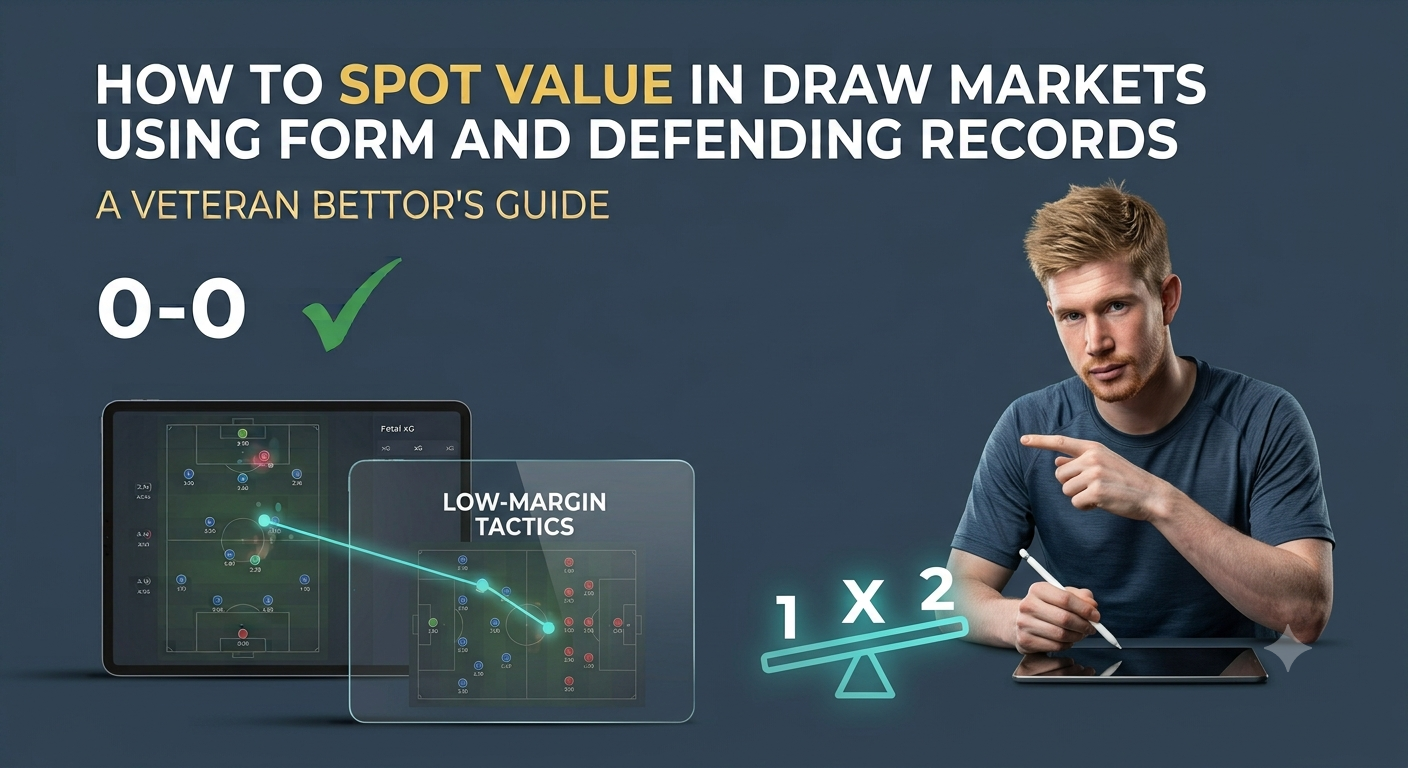
Analyse the teams’ performances over 6-10 matches and pay attention to see if they have low-margin outcomes. This just means that they consistently have games that end in a single goal. These types of teams are usually well structured in their defense but lack that massive attacking power.
Strong home record:
If a team that has a good home record faces a superior team that just lacks that winning factor, the game would most likely end in a draw.
Recent Draws:
Teams that have drawn two or three of their last five matches are rarely based on coincidence. Most times, it indicates a coach who favours a defensive structure over risking attack. So if two such teams collide, a draw would be more likely.
2. Defense records and xGA Metrics:
Before placing any bet on the draw market, you must confirm that at least one side possesses a strong defensive structure.
xGA is Expected Goals Against, and it simply provides a clearer picture of a team's defensive strength. So, you have to look for matches where both teams have low xG (Expected Goals) and xGA (Expected Goals Against).
Additionally, research the average number of shots inside the team's penalty box, their clean sheet rates, and their defense structure under pressure. If all these stats, except the latter, are low, then it means that they are a favourable team to bet on for a draw.
Also, if the teams are missing key center-backs or anchor midfielders, this should discourage you from betting on them in the draw market. Read our Premier League fixtures analysis to get more updates and strategically place your bets.
The draw market is often neglected, but you would find that it is a very lucrative avenue to get profits.
Just carefully analyse the metrics and place your wager accordingly. Get more tips here.
Frequently Asked Questions (FAQ)
What is the average probability of a draw in top European football leagues?
Across major European leagues—such as the Premier League, La Liga, Serie A, and Bundesliga—approximately 23% to 27% of all matches end in a draw over a full season. However, in specific low-scoring leagues or lower divisions, that rate can rise above 30%.
What scoreline is the most common for a draw?
The most frequent draw scoreline in professional football is 1-1, accounting for roughly 40% to 45% of all level finishes. The second most common draw outcome is 0-0, followed by 2-2. High-scoring draws like 3-3 or 4-4 are statistically rare.
Is it better to bet on draws as singles or accumulators?
Draws should almost exclusively be bet as single wagers. Because draw probabilities are lower than traditional win markets, combining multiple draws into accumulators (parlays) creates extreme variance that is difficult to sustain over a long sample size.
How do "Under 2.5 Goals" odds correlate with draw probability?
There is a strong positive correlation between low total goals and draws. When the market expects fewer than 2.5 goals, the range of probable scorelines shrinks down to 0-0, 1-0, 0-1, and 1-1—meaning the draw represents a much higher percentage of the total outcome distribution.
Does extra time count for draw bets in cup competitions?
No. Standard 1X2 draw wagers apply strictly to regulation time (90 minutes plus added stoppage time). If a cup match ends 1-1 after 90 minutes and goes to extra time or penalties, your draw wager settles as a win regardless of who wins during extra time.
How does a red card affect draw probabilities mid-match?
In live in-play betting, an early red card generally decreases the likelihood of a draw because the numerical imbalance creates tactical gaps and fatigue. However, if a favorite receives a late red card while tied, they may retreat into a compact low block to protect the single point, often freezing the level scoreline in place.
What is the difference between backing a Draw and betting on "Draw No Bet" (DNB)?
A standard draw wager is a 3-way bet (1X2) where you profit specifically when the match ends level. "Draw No Bet" (DNB) is a 2-way market where you pick either Team A or Team B to win; if the match ends in a draw, your stake is fully refunded rather than won or lost.
Are there specific leagues that record higher draw percentages than others?
Yes. Leagues characterized by lower scoring rates, defensive tactical emphasis, or tighter quality parity—such as the English Championship, Italian Serie B, or France's Ligue 2—historically record higher draw percentages than top-heavy, high-scoring competitions like the German Bundesliga.
How do late-game substitutions impact draw likelihoods?
Managers holding a level scoreline late in the second half often make defensive or time-wasting substitutions (e.g., swapping a winger for an extra defensive midfielder) to secure a point. Recognizing a manager's tendency to defend a draw rather than chase a late winner provides valuable context for live, in-play draw wagers.